 RadiologyQuizLab
ARRT CT REGISTRY · SECTIONAL ANATOMY
CT registry anatomy
On the ARRT computed tomography exam, anatomy isn't a separate paper — it runs through the whole Procedures section, which carries 71 of the 165 scored questions. Any study you're asked about, from the temporal bones to the pancreas, can come with a question on its cross-sectional anatomy. This guide shows where anatomy sits in the exam, what to learn region by region and how to study it — then lets you practice the skill on real CT images, free.
The anatomy skill, in one question — read the slice, name the marked structure:
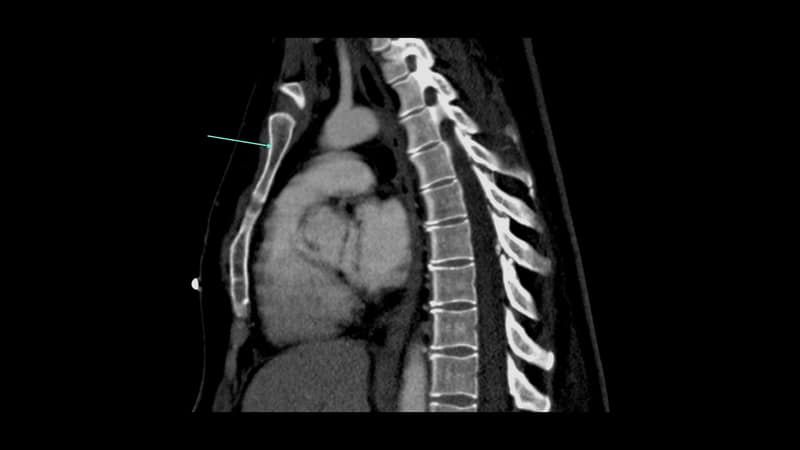
Which anatomical structure is arrowed?
Single answer — type the structure
Correct — Manubrium of sternum
Where anatomy sits in the CT registry
The CT registry is the ARRT's certification exam in computed tomography, most often taken by radiologic technologists moving into CT. Its content specifications split the exam into four categories: Patient Care, Safety, Image Production and Procedures. Procedures is the largest, and for every type of study it lists, the questions may focus on cross-sectional anatomy, landmarks and vasculature — alongside imaging planes, protocols and contrast.
Exam format at a glance
Under the current content specifications (in effect since July 2022), the exam has 165 scored questions plus 30 unscored pilot questions, taken on computer. Procedures accounts for 71 of them: head, spine and musculoskeletal (25), neck and chest (21), and abdomen and pelvis (25). Most items are single-best-answer multiple choice. The outline is revised periodically, so always confirm the current version on the official ARRT page.
Official exam details — ARRT Computed Tomography →
What's tested, region by region
Head: temporal bones and internal auditory canals, orbits, sinuses, facial bones and mandible, TMJs and the brain. Spine: cervical down to the sacrum and coccyx. Musculoskeletal: shoulder and scapula, upper and lower extremities, bony pelvis and hips. Neck: larynx, airway and soft tissues. Chest: mediastinum, lungs, heart, airway and chest wall. Abdomen and pelvis: liver, biliary tree, spleen, pancreas, adrenals, kidneys and ureters, GI tract, bladder, rectum and reproductive organs. Vasculature runs through all of it — CTA and CTV studies make the major arteries and veins fair game in every region.
How to study the anatomy
Learn each region on real axial slices first — axial is how CT is acquired and read — then check the same structures on coronal and sagittal reformats. Anchor every study on its landmarks: the great vessels in the chest, the portal and hepatic veins in the liver, the ventricles in the head. Then add the smaller structures around them. Use active recall: look at the marked structure, name it before you see the answer, then check. If you can name a structure unprompted, recognizing it among the options on exam day is easy. Anatomy is one part of the exam, so pair it with a full registry review for physics, dose and patient care.
CT registry anatomy: common questions
How much of the CT registry is anatomy?
There's no standalone anatomy section. Anatomy is one of the focuses of the Procedures category, which has 71 of the 165 scored questions — so a large share of the exam draws on cross-sectional anatomy, landmarks and vessels. Check the current content specifications on the ARRT website for the exact breakdown.
What's the passing score for the CT registry?
The ARRT reports results as a scaled score, and a scaled score of 75 is needed to pass. It isn't a percentage of questions answered correctly. Confirm the current scoring rules on the ARRT website.
Are there free CT registry practice questions for anatomy?
Yes — you can practice naming structures on real CT images here, free and without an account. It covers the anatomy side of the exam; for physics, safety and patient care, use a dedicated registry review.
What's the best book for CT sectional anatomy?
Many technologists study from a sectional anatomy atlas such as Kelley and Petersen's Sectional Anatomy for Imaging Professionals. A book shows you the anatomy; naming structures on real images, again and again, is what makes it stick for exam day.
Ready to lock in the anatomy?
Get 20 free questions across 8 body regions — name the structure, get the explanation, and track what sticks. No card needed.
Practice free — 20 questions